In short: an adiabatic cooler runs dry for most of the year and wets its air inlet only on the hottest days, so it uses a fraction of the water of a cooling tower while reaching temperatures a dry cooler cannot. For Saudi plants paying for make-up water and water treatment, it is often the best balance of water, power and footprint. BTGC supplies Baltimore Aircoil (BAC) adiabatic, hybrid and closed-circuit coolers in Saudi Arabia.
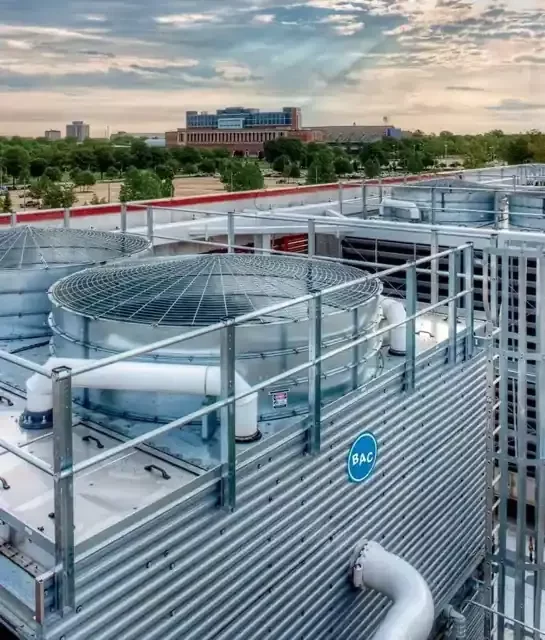
A conventional open cooling tower evaporates about 1.8 litres of water for every kilowatt-hour of heat it rejects, and bleeds off more to control dissolved solids. For a 10 MW cooling load that is tens of thousands of cubic metres a year, bought from the industrial-city utility, treated with chemicals and sent to drain. A dry cooler uses no water but cannot cool below the air temperature plus an approach, which on a 46 °C day is not useful for most processes. The adiabatic cooler sits between the two.
How it works
An adiabatic cooler is a dry, finned-coil cooler with an evaporative pre-cooling stage on the air inlet. Below a set air temperature the pads or spray stay off and the unit runs as a dry cooler. When the air temperature rises, water wets the inlet pads; the air cools by evaporation before it reaches the coil, and the coil sees air close to the wet-bulb temperature rather than the dry-bulb. In Dammam in July that difference is 15 to 20 °C.
| Cooler type | Water use | Lowest fluid temperature | Footprint |
|---|---|---|---|
| Open cooling tower | High, continuous | Wet-bulb + 3 to 5 °C | Small |
| Closed-circuit cooling tower | High, continuous | Wet-bulb + 4 to 6 °C | Small |
| Adiabatic cooler | Low, only in hot hours; 60 to 90 per cent less than a tower | Wet-bulb + 8 to 12 °C in adiabatic mode | Medium |
| Dry cooler | None | Dry-bulb + 5 to 10 °C | Large |
Where adiabatic cooling fits in Saudi plants
Compressor and chiller condensers in factories and data centres where water supply is metered and limited.
Closed-loop cooling for furnaces, presses and injection moulding in the industrial cities.
Process cooling at inland sites without a seawater or treated effluent supply.
Replacement of ageing open towers where the owner wants to stop water treatment and legionella management on open water.
Water quality and hygiene
Because the water in an adiabatic cooler only wets the pads and drains away, there is no recirculating open basin, so the legionella risk and the chemical treatment load are far lower than on a tower. BAC's designs use pads that dry completely between cycles and controls that flush the water system, which simplifies compliance with the operator's water safety plan. Make-up water can be the utility supply; softening is advised where the water is hard, to keep the pads clean.

Baltimore Aircoil from BTGC
Baltimore Aircoil Company builds adiabatic coolers and condensers (TrilliumSeries and Nexus ranges), closed-circuit coolers, open cooling towers and evaporative condensers in the USA and Belgium. BTGC is the BAC partner in Saudi Arabia, from selection and supply to spare parts and refurbishment. The earlier article covers closed-circuit cooling towers for process water; see also the process and thermal page and the petrochemicals sector page.
Questions buyers ask
How many hours a year does the adiabatic mode run? In the Eastern Province typically 1,500 to 2,500 hours, depending on the set point; the rest of the year the unit is dry.
Can an adiabatic cooler replace a tower one for one? Usually with a larger footprint and a slightly higher design fluid temperature; BTGC runs the selection with BAC's software on the site weather data.
What maintenance does it need? Pad inspection and replacement every few years, coil cleaning and fan and control checks; no basin cleaning or biocide dosing.
Contact BTGC
Email info@btc-ksa.com or call +966 13 856 0528. Branches: Dammam, Jubail and Yanbu. Request a quote.