In short: local pressure gauges look simple, but on pumps, compressors and reciprocating machines they often fail within months: the pointer flutters, the movement wears and the Bourdon tube cracks. The fixes are well known: liquid-filled cases to damp vibration, snubbers or restrictors to calm pulsation, diaphragm seals to keep corrosive, viscous or hot media out of the gauge, and correct range selection so normal pressure sits in the middle of the scale. EN 837 sets the main design and accuracy rules. BTGC supplies Nuova Fima gauges, seals and thermometers.
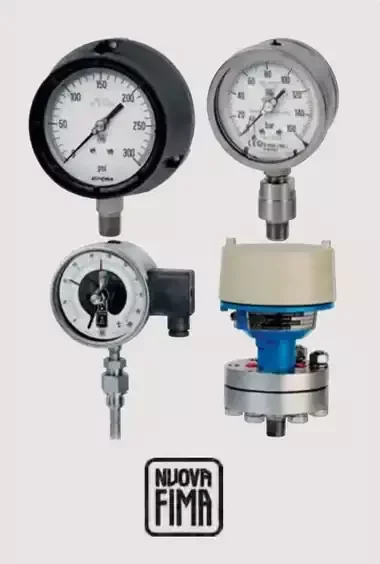
Plant operators rely on local gauges during start-up, troubleshooting and rounds. A gauge that reads wrong or has failed hides real problems, and a cracked Bourdon tube can release process fluid. In Saudi plants, heat, sun and sand add to the load on gauges installed outdoors.
Common problems and fixes
| Problem | Cause | Fix |
|---|---|---|
| Pointer flutter, worn movement | Machine vibration | Glycerine or silicone filled case; remote mounting with capillary |
| Pointer swinging, cracked Bourdon tube | Pressure pulsation from reciprocating pumps or compressors | Snubber, restrictor screw or pulsation damper; gauge with damped movement |
| Blocked or corroded element | Corrosive, viscous, crystallising or dirty media | Diaphragm seal with suitable wetted materials and fill fluid |
| Overrange damage | Pressure spikes or wrong range | Range so normal pressure is in the middle third of the scale; overpressure protector |
| Wrong reading in hot service | Heat reaching the gauge | Siphon for steam, cooling tower or diaphragm seal with capillary |
Selection points
Accuracy class to EN 837-1, for example class 1.0 for process gauges and 0.25 or better for test gauges.
Case and wetted parts in stainless steel for outdoor and corrosive locations; safety pattern case with blow-out back and solid front for gas and high pressure service.
Dial size for readability from the operating position, commonly 100 or 150 mm.
Diaphragm seal fill fluid suited to the process temperature and approved for food or pharma where needed.
Sour service materials where H2S is present.

Maintenance and calibration
Calibrate on a schedule against a reference, and replace gauges that fail calibration rather than adjusting repeatedly.
Check liquid level in filled gauges and look for leaks or discoloured fill.
Inspect diaphragm seals for damage after process upsets.
Record gauge failures by location; repeat failures show where a snubber or seal is needed.
Pair local gauges with transmitters for critical points so readings can be trended; see API Plan 53 seal support systems.
Nuova Fima from BTGC
Nuova Fima of Italy makes pressure gauges, diaphragm seals, thermometers, transmitters and switches for oil and gas, petrochemical and power plants. BTGC is the Nuova Fima partner in Saudi Arabia. See also the petrochemicals sector and oil and gas sector pages.
Questions buyers ask
Does liquid filling help with pulsation? It damps vibration and some pulsation, but strong pulsation also needs a snubber or damper.
When is a diaphragm seal needed? For corrosive, viscous, crystallising, hot or hygienic media that must not enter the gauge element.
Can BTGC supply gauges with calibration certificates? Yes, with factory calibration certificates and material certificates on request.
Contact BTGC
Email info@btc-ksa.com or call +966 13 856 0528. Branches: Dammam, Jubail and Yanbu. Request a quote.