In short: substations, control rooms, UPS systems and emergency shutdown systems all depend on batteries, and heat is their biggest enemy. Lead-acid batteries are rated at 20 to 25 °C, and their life roughly halves for every 8 to 10 K above that. Nickel-cadmium (NiCd) batteries tolerate high temperatures much better, survive deep discharge and have a predictable end of life, at a higher first cost. The choice depends on room cooling, required life and how critical the load is. BTGC supplies Hoppecke NiCd and lead-acid batteries.
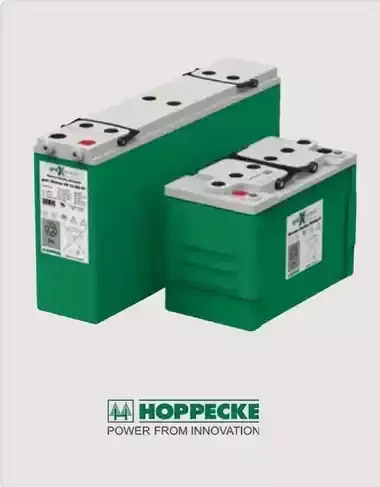
Many substations and remote plant buildings in the Kingdom see indoor temperatures well above 30 °C when air conditioning fails or is undersized. Batteries in these rooms reach end of life early, and the failure often shows only when the DC system is needed during a fault.
NiCd and lead-acid compared
| Feature | Nickel-cadmium (NiCd) | Valve-regulated lead-acid (VRLA) |
|---|---|---|
| High temperature tolerance | Good; moderate life reduction at high temperature | Poor; life falls sharply above 25 °C |
| Typical design life | 20 years or more | 10 years or less in practice in hot rooms |
| Failure mode | Gradual capacity loss, predictable | Can fail suddenly (dry-out, thermal runaway) |
| Deep discharge | Tolerates it well | Damages the battery |
| Maintenance | Periodic topping up for vented types | No topping up, but needs monitoring |
| First cost | Higher | Lower |
Sizing and design points
Size to IEEE 1115 for NiCd or IEEE 485 for lead-acid, using the duty cycle of the DC loads.
Apply temperature, ageing and design margin factors; heat derating is significant in Saudi conditions.
Set float and boost voltages for the battery type, with temperature compensation on the charger for VRLA.
Ventilate battery rooms for hydrogen as required by IEC 62485-2.
Provide battery monitoring for critical systems: cell voltages, temperature and impedance.
Testing and maintenance
Visual inspection and float voltage checks at regular intervals; check electrolyte level on vented cells.
Impedance or conductance trending to find weak cells in VRLA strings.
Capacity (discharge) tests at commissioning and at intervals during life, as IEEE 1106 and IEEE 1188 describe.
Keep connections tight and clean; check with thermography.
Replace strings as a whole when capacity falls below about 80 percent.
Hoppecke from BTGC
Hoppecke of Germany makes industrial batteries, including NiCd ranges for utilities, oil and gas, and rail, and lead-acid batteries for stationary power. BTGC is the Hoppecke partner in Saudi Arabia. See also transformer protection devices, the electrical power systems page and the electrical power systems page.
Questions buyers ask
Can lead-acid batteries be used in a hot substation? Yes, if the room is reliably cooled; otherwise expect much shorter life.
How often should batteries be capacity tested? At commissioning, then every few years, and more often as they near end of life.
Does BTGC supply complete DC systems? Yes, batteries with racks, chargers and monitoring on request.
Contact the BTGC power division
Email power@btc-ksa.com or call +966 13 856 0528. Branches: Dammam, Jubail and Yanbu. Request a quote.