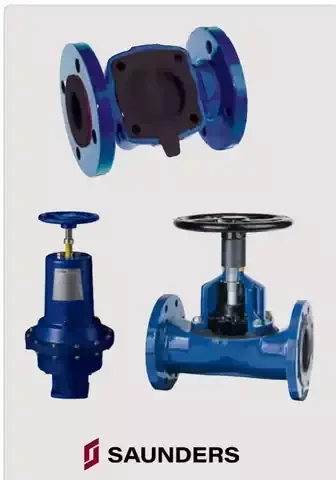
In short: in pharmaceutical, biotech, food, dairy and purified water systems, a valve must not only shut off but also stay clean. Hygienic diaphragm valves isolate the process fluid from the stem and body mechanism with a flexible diaphragm, have no pockets where product can collect, and can be cleaned in place and steam-sterilised. Correct installation angle for drainability, the right diaphragm material and planned diaphragm changes keep them reliable. BTGC supplies Saunders industrial and hygienic diaphragm valves.
Pharmaceutical manufacturing, dairies, beverage plants and the purified water and water-for-injection systems that support them are growing in the Kingdom. Regulators and auditors expect equipment that can be shown to be cleanable and free of contamination risk.
Why diaphragm valves suit hygienic service
The diaphragm is the only moving part in contact with the product, so the bonnet, stem and spring never touch it.
The weir design gives a smooth, crevice-free flow path that drains when installed at the correct angle.
They can be cleaned in place (CIP) and sterilised in place (SIP) with steam.
Zero-static and tank-bottom designs remove dead legs at branches and vessel outlets.
Key specification points
| Item | What to look for |
|---|---|
| Standard | Design and documentation in line with ASME BPE for bioprocessing equipment |
| Body material and finish | 316L stainless steel, with internal surface roughness and electropolishing to the specified grade |
| Diaphragm | EPDM or PTFE-faced diaphragms with food-contact and pharmacopoeia compliance, chosen for the cleaning chemicals and steam temperatures |
| Drainability | Marked drain angle so the valve empties fully when installed on sloped lines |
| Documentation | Material certificates, surface finish records and elastomer compliance documents |
Installation and maintenance
Install each valve at its marked drain angle; a valve fitted level can hold liquid behind the weir.
Track SIP cycles and replace diaphragms on a fixed schedule rather than waiting for leaks.
Use the correct bonnet torque after diaphragm changes; overtightening damages the diaphragm.
Inspect diaphragms for cracking, compression set and discolouration at each change.
Keep a stock of diaphragms for critical systems; a failed diaphragm can stop a production line.
Industrial diaphragm valves too
The same principle, with rubber-lined bodies, serves abrasive and corrosive slurries in mining and water treatment, as described in sleeved plug and diaphragm valves for polymers and slurry.
Saunders from BTGC
Saunders, the inventor of the diaphragm valve and part of Crane ChemPharma and Energy, makes industrial and aseptic diaphragm valves. BTGC is the Saunders partner in Saudi Arabia. See also valve body materials and the flow control and valves page.
Questions buyers ask
How often should diaphragms be replaced? It depends on temperature, SIP cycles and chemicals; many plants replace them at set intervals based on cycle counts and inspection results.
EPDM or PTFE-faced diaphragm? EPDM suits water and steam; PTFE-faced diaphragms resist a wider range of chemicals and solvents.
Can BTGC supply spare diaphragms? Yes, genuine Saunders diaphragms and bonnet assemblies.
Contact the BTGC valve team
Email valves@btc-ksa.com or call +966 13 856 0528. Branches: Dammam, Jubail and Yanbu. Request a quote.