In short: cooling towers create warm, wet conditions where Legionella bacteria can grow and spread in drift. Hot climates make control more important, not less. Design details, water treatment, regular cleaning and a written risk assessment keep the risk low. BTGC supplies Baltimore Aircoil cooling towers and supports owners with inspection and refurbishment.
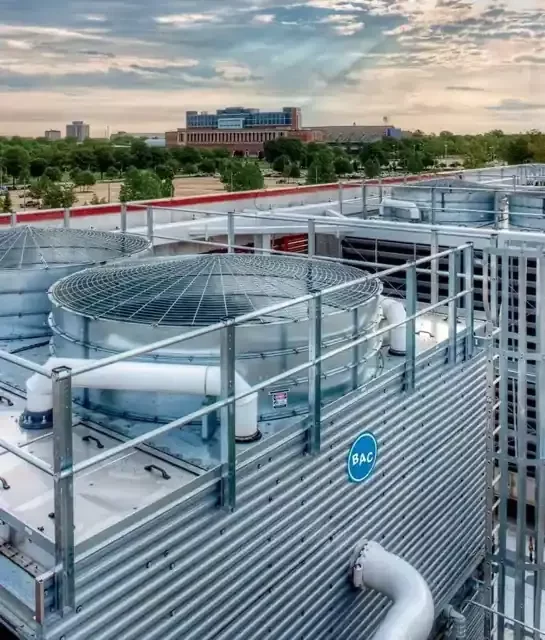
Legionella bacteria live in water between about 20 and 45 °C and multiply fastest near body temperature, which is exactly the range of many cooling tower basins in the Kingdom. People are infected by breathing fine water droplets, so towers near air intakes, offices or public areas need particular care. Good practice is set out in guidance such as ASHRAE 188 and similar international codes.
Where the risk comes from
| Factor | Why it matters |
|---|---|
| Stagnant water | Dead legs, idle standby towers and low-flow basins let bacteria grow |
| Biofilm and sludge | Protect bacteria from biocide |
| Drift | Carries droplets away from the tower |
| Poor water treatment | Lets scale, corrosion and biofouling build up |
A control programme that works
Risk assessment and written plan naming who does what and how often.
Continuous water treatment with biocide, scale and corrosion control, and monitoring of dosing.
Routine testing for total bacteria and periodic Legionella sampling.
Cleaning and disinfection of basins and fill at set intervals and after any positive result.
Mechanical upkeep: effective drift eliminators, clean fill, no dead legs, covered basins.

Design choices that reduce risk
Closed-circuit coolers keep the process fluid out of contact with air, and adiabatic coolers use far less recirculating water, which reduces the risk further. Where open towers are needed, high-efficiency drift eliminators, sloped and accessible basins and materials that resist biofilm help. See also closed-circuit cooling towers.
Baltimore Aircoil from BTGC
Baltimore Aircoil Company builds open and closed-circuit cooling towers, evaporative condensers and adiabatic coolers. BTGC is the BAC partner in Saudi Arabia for new equipment, spare parts and refurbishment. See the process and thermal page.
Questions buyers ask
How often should a cooling tower be cleaned? At least twice a year in most programmes, and after any positive Legionella result.
Do closed-circuit coolers need a Legionella plan? Yes, because the spray water is still open to air, but the risk is lower.
Can old towers be upgraded? Often, with new drift eliminators, fill and basin modifications; BTGC surveys the tower first.
Contact BTGC
Email info@btc-ksa.com or call +966 13 856 0528. Branches: Dammam, Jubail and Yanbu. Request a quote.