In short: reverse osmosis membranes need clean feed water. Ultrafiltration removes suspended solids, colloids, algae and bacteria and gives RO feed with a low and stable silt density index, even when the sea turns turbid or an algae bloom arrives. Compared with media filters it is more compact and more consistent, but it needs regular backwashing, chemical cleaning and integrity checks. The same technology prepares treated wastewater for reuse. BTGC supplies Pentair X-Flow ultrafiltration membranes and Codeline housings.
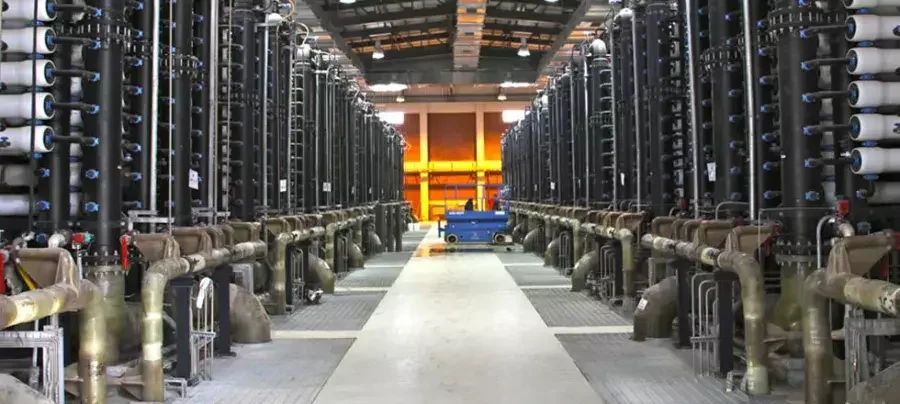
Gulf and Red Sea water is warm and saline, and algae blooms can arrive quickly; during past red tide events in the Gulf, several plants had to cut production. Pretreatment is therefore the part of an SWRO plant that most often limits output. Large plants in the region now combine dissolved air flotation (DAF) with ultrafiltration. In Kuwait, the 350,400 m³ a day Shuwaikh SWRO plant uses DAF followed by pressurised inside-out X-Flow ultrafiltration, keeping RO feed SDI consistently below 3 even through red tide turbidity of up to about 31 NTU.
What ultrafiltration does
Membranes with very fine pores, typically around 0.01 to 0.1 micrometre, act as a physical barrier to particles, colloids, algae, bacteria and most viruses.
Typical targets for RO feed are SDI below 3 (often below 2.5) and turbidity around 0.1 NTU or lower.
Output quality stays stable as raw water quality changes, which protects the RO membranes and reduces RO cleaning.
Ultrafiltration or media filters?
| Factor | Ultrafiltration | Dual media filters |
|---|---|---|
| Filtrate quality | Consistent, very low SDI | Varies with raw water and filter condition |
| Response to algae blooms | Good, especially with DAF upstream | Breakthrough risk |
| Footprint | Compact | Large |
| Operation | Backwash, chemically enhanced backwash, cleaning and integrity tests | Backwash and media replacement |
| Chemicals | Cleaning chemicals; little coagulant | Coagulant dosing normally needed |
Running a UF plant well
Trend transmembrane pressure and permeability; a steady rise means fouling that backwash no longer removes.
Set backwash and chemically enhanced backwash frequency to the water: more often during blooms.
Run regular integrity (pressure decay) tests and repair or isolate damaged modules quickly.
Keep pre-screens in good order to protect fibres from shells and debris.
Coordinate chlorination with membrane chemical limits.
Water reuse
Treated sewage effluent is a growing source of industrial and irrigation water in the Kingdom. UF followed by RO turns secondary effluent into high-quality water for cooling towers, boilers and process, as described in cooling tower water.
X-Flow and Codeline from BTGC
BTGC is the Pentair partner in Saudi Arabia for X-Flow ultrafiltration membranes and Codeline membrane pressure vessels. Intake protection is supplied by Elgin. See the power and utilities sector page.
Questions buyers ask
Can UF replace existing media filters in an operating plant? Often yes, as a phased retrofit; the space saved can be significant. A pilot test on site water is recommended.
How long do UF membranes last? Typically several years, depending on water quality, cleaning practice and operation.
What data does BTGC need? Raw water analysis, flow, the RO design and the existing pretreatment arrangement.
Contact BTGC
Email info@btc-ksa.com or call +966 13 856 0528. Branches: Dammam, Jubail and Yanbu. Request a quote.