In short: a cooling tower cools water by evaporating part of it, and the dissolved salts left behind concentrate in the circulating water. Blowdown removes concentrated water to keep salts below scaling and corrosion limits, and make-up replaces both. Cycles of concentration describe that balance, and raising them safely is the main way to cut cooling tower water use. In the Kingdom, where water is costly and make-up may be desalinated, treated effluent or high in minerals, getting the balance right matters. BTGC supplies Baltimore Aircoil cooling towers and parts.
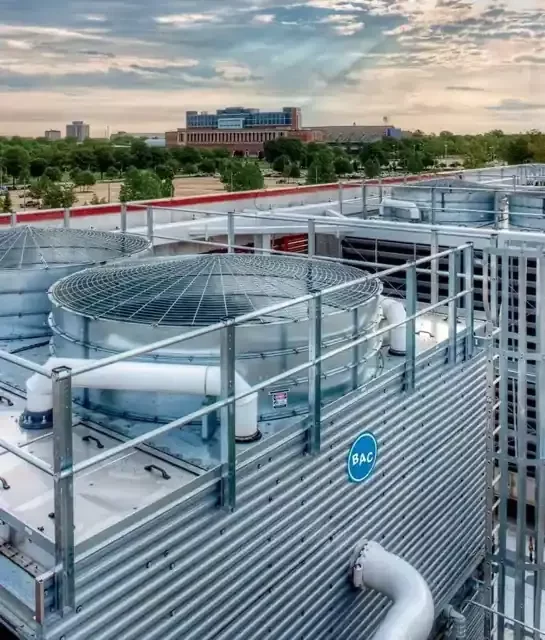
A cooling tower evaporates roughly 1 per cent of the circulating flow for every 5.5 to 6 °C of cooling range. At large plants that adds up to thousands of cubic metres a day, plus blowdown. Water treatment and tower operation decide how much extra water is lost to blowdown and whether the system stays free of scale and corrosion.
The water balance
| Term | Meaning |
|---|---|
| Evaporation (E) | Water lost as vapour; carries the heat away and leaves salts behind |
| Blowdown (B) | Water deliberately drained to limit salt concentration |
| Drift (D) | Droplets carried out with the air; small with good drift eliminators |
| Make-up (M) | Water added to replace evaporation, blowdown and drift: M = E + B + D |
| Cycles of concentration (COC) | Ratio of dissolved solids in the circulating water to those in the make-up; blowdown is roughly E / (COC - 1) |
Why cycles matter
Raising cycles from 2 to 5 cuts blowdown by about three quarters for the same evaporation, because blowdown is roughly evaporation divided by cycles minus one. The limit is set by the chemistry: calcium, silica, sulphate and chloride levels, alkalinity and pH. Above the safe limit, scale forms on fill and in exchangers, or corrosion accelerates. Good treatment programmes raise the safe cycles with scale and corrosion inhibitors and control them with conductivity-based automatic blowdown.

Make-up water in Saudi Arabia
Desalinated water is low in hardness, allowing high cycles, but it can be aggressive to metals and needs corrosion control.
Groundwater is often high in hardness, silica and sulphate, which limits cycles; softening or side-stream treatment can help.
Treated sewage effluent is increasingly used for cooling and needs attention to nutrients, biological growth and ammonia.
Seawater towers use special materials and run at low cycles.
Operating practices
Control blowdown automatically on conductivity, not on fixed timers or manual valves.
Meter make-up and blowdown to track cycles and spot leaks or overflows.
Keep drift eliminators in place and in good condition.
Use side-stream filtration in dusty locations to keep suspended solids out of fill and exchangers.
Coordinate biocide treatment with Legionella control, as described in Legionella control in cooling towers.
Reducing water use further
Where water is very scarce, closed-circuit coolers that can run dry in cooler months, adiabatic coolers or hybrid systems cut water use further; see adiabatic coolers and why cooling towers lose capacity.
Baltimore Aircoil from BTGC
Baltimore Aircoil Company builds open and closed-circuit cooling towers, evaporative condensers and adiabatic coolers. BTGC is the BAC partner in Saudi Arabia for new equipment, spare parts and refurbishment. See the process and thermal page.
Questions buyers ask
How many cycles can our tower run? It depends on the make-up water chemistry, the treatment programme and the system materials; a water treatment specialist sets the limit from water analysis.
Can blowdown be reused? Sometimes, for example for irrigation or other non-potable uses, if its quality meets local requirements.
Does tower design affect water use? Evaporation is set by the heat load, but drift, splash-out and the option of dry operation depend on the design.
Contact BTGC
Email info@btc-ksa.com or call +966 13 856 0528. Branches: Dammam, Jubail and Yanbu. Request a quote.