In short: a cooling tower that sends water back 2 or 3 degrees warmer than design costs real money: chillers use more power, condensers lose vacuum and process coolers limit production, usually in the hottest weeks of the year. Most lost capacity comes from a short list of causes: fouled or damaged fill, blocked distribution nozzles, reduced airflow, recirculation of hot exhaust air and poor water treatment. Each can be measured and fixed. BTGC supplies Baltimore Aircoil cooling towers, spare parts and refurbishment support.
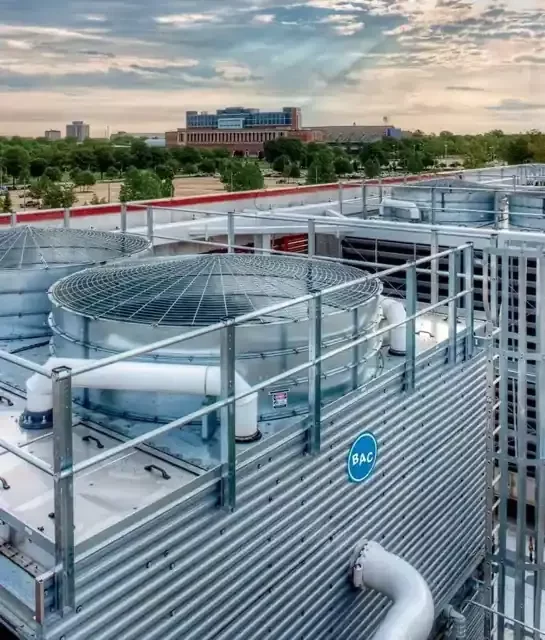
Tower performance is described by three temperatures: the hot water returning, the cold water leaving and the ambient wet-bulb temperature. The range is hot water minus cold water; the approach is cold water minus wet bulb. A tower designed for a 4 K approach that has drifted to 7 K is delivering far less cooling than its nameplate, and the cause is almost always physical.
Common causes of lost capacity
| Cause | What happens | How to check |
|---|---|---|
| Fouled or scaled fill | Water channels instead of spreading, leaving less surface for heat transfer; heavy fill can sag or collapse | Inspect fill sections, weigh a sample pack, look for sagging |
| Blocked or missing nozzles | Dry areas in the fill and air short-circuiting | Inspect the distribution basin or spray branches with water running |
| Reduced airflow | Belt slip, wrong fan pitch, worn drives, blocked inlet louvres or eliminators | Measure fan motor current and airflow; check belt tension and blade angle |
| Recirculation | Hot humid exhaust drawn back into the inlet raises the effective wet bulb | Measure inlet wet bulb against ambient; review layout and nearby walls |
| Overloaded tower | More heat or flow than the design point | Measure flow and range against design |
| Poor water treatment | Scale and biofilm on fill and in exchangers | Review cycles of concentration, dosing and test results |
Testing performance
A performance test measures water flow, hot and cold water temperatures, wet bulb and fan power, and compares the result with the tower's performance curves. The Cooling Technology Institute's acceptance test code, CTI ATC-105, is the reference method. Even a simple test with calibrated instruments on a stable day shows whether the tower meets its curve and how much capacity has been lost.
Recovering capacity
Clean or replace fill. Lightly fouled fill can be cleaned; scaled or collapsed fill is replaced, often with a modern film fill that gives more performance in the same space.
Restore distribution. Clear and replace nozzles, and repair basin covers and spray branches.
Restore airflow. Re-pitch fan blades to the design angle, replace worn belts and drives, clean inlet louvres and drift eliminators.
Stop recirculation. Extend fan stacks or modify enclosures where exhaust air is drawn back.
Tighten water treatment. Control scale and biofilm, which also reduces Legionella risk, as covered in Legionella control in cooling towers.
When to consider a different design
Where a site needs more cooling than the original tower can give, options include adding cells, upgrading fill and fans, or moving to closed-circuit cooling towers or adiabatic coolers where water is scarce.
Baltimore Aircoil from BTGC
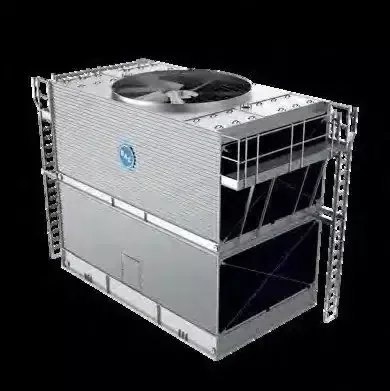
Baltimore Aircoil Company builds open and closed-circuit cooling towers, evaporative condensers and adiabatic coolers. BTGC is the BAC partner in Saudi Arabia for new equipment, spare parts and refurbishment. See the process and thermal page.
Questions buyers ask
How much does fouled fill cost? It depends on the system, but every degree of extra cold water temperature raises chiller power and lowers condenser and process performance; a test puts a number on it.
Can fill be replaced without replacing the tower? Yes. Fill, eliminators, nozzles and fans can be replaced in most towers; BTGC surveys the tower first.
When is the best time to refurbish? In the cooler months before summer, so the tower is ready for peak demand.
Contact BTGC
Email info@btc-ksa.com or call +966 13 856 0528. Branches: Dammam, Jubail and Yanbu. Request a quote.