In short: a feeder controls how fast bulk material leaves a hopper, bin or stockpile and enters a crusher, conveyor or kiln. Choose the wrong type and the line floods, starves, jams or wears out quickly. Vibrating feeders suit free-flowing material with moderate lumps; apron feeders handle large, heavy lumps and impact; belt feeders give accurate rates on fine, free-flowing material; screw feeders handle fine powders and fibrous fuels. The hopper outlet above matters as much as the feeder. BTGC supplies TerraSource Global feeding and size reduction equipment.
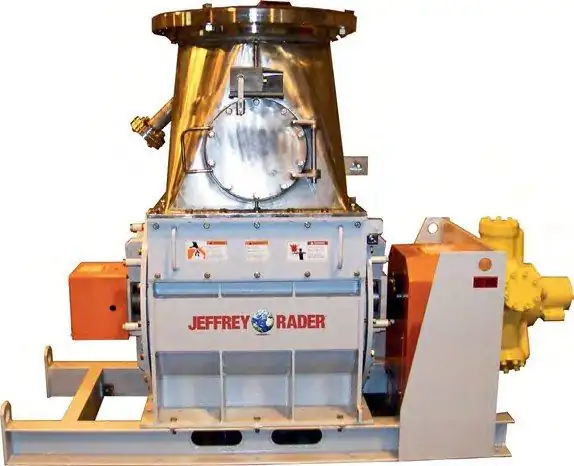
In cement plants, mines, ports and power plants, the feeder is where storage meets process. A crusher needs a steady feed to work efficiently, a kiln burner needs a steady fuel rate, and a conveyor needs even loading to avoid spillage. Many feed problems that look like crusher or conveyor problems start at the feeder or the hopper outlet.
Feeder types compared
| Feeder | Best for | Limits |
|---|---|---|
| Vibrating (electromechanical or electromagnetic) | Free-flowing granular material with moderate lumps; scalping fines before a crusher | Sticky or very wet material, very large lumps, very high head loads |
| Apron (pan) feeder | Large, heavy, abrasive lumps; high impact from dump trucks; primary crusher feed | Higher cost and weight; less accurate rate |
| Belt feeder | Fine to medium free-flowing material where an accurate rate is needed | Impact and sharp lumps damage the belt; spillage at skirts |
| Screw feeder | Fine powders and fibrous or sticky fuels, enclosed handling | Abrasive material wears flights; limited lump size |
| Rotary drum and reclaim feeders | Reclaiming from stockpiles, silos and fuel storage | Specific layouts |
The hopper decides how the feeder behaves
A feeder can only deliver what the hopper releases. Funnel-flow hoppers with shallow walls let material form stagnant zones, ratholes and arches, then release it in surges. Mass-flow hoppers, with walls steep and smooth enough for all the material to move, give even flow but must be designed from the material's measured flow properties. The feeder must also draw evenly along the whole outlet, otherwise only the front of the hopper discharges. Flow tests on the actual material are the basis of good hopper and feeder design.
Common feed problems and fixes
Flooding of fine, aerated material: use a feeder that seals the outlet, such as a screw or rotary feeder, or reduce aeration.
Arching and ratholing: redesign the outlet or walls, or add flow aids, rather than hammering the hopper.
Uneven draw: fit a tapered or expanding interface between hopper and feeder.
Rapid wear: use replaceable liners and choose a feeder rated for the impact and abrasiveness.
Inaccurate rate: add variable speed control and, where needed, a weigh feeder.
Alternative fuels and biomass
Refuse-derived fuel, tyre chips and biomass are fibrous and variable, and they bridge easily. They need feeders and storage designed for those properties, as discussed in alternative fuel handling for cement kilns and biomass size reduction. For crushing after the feeder, see crusher wear parts.
TerraSource Global from BTGC
TerraSource Global, owned by Astec Industries, brings together Jeffrey Rader, Gundlach Crushers and Pennsylvania Crusher, with feeders, storage and reclaim systems, crushers and screens. BTGC is the TerraSource Global partner in Saudi Arabia. See also the mining and material handling page.
Questions buyers ask
Can a vibrating feeder handle wet material? Moderately damp material is fine; wet, sticky material tends to build up, and a different feeder type or liner may be needed.
What information is needed to size a feeder? Material type, bulk density, lump size, moisture, required rate range, hopper outlet dimensions and how material is loaded.
Can material be tested before selection? TerraSource can test material samples to support equipment selection; BTGC arranges it.
Contact BTGC
Email info@btc-ksa.com or call +966 13 856 0528. Branches: Dammam, Jubail and Yanbu. Request a quote.