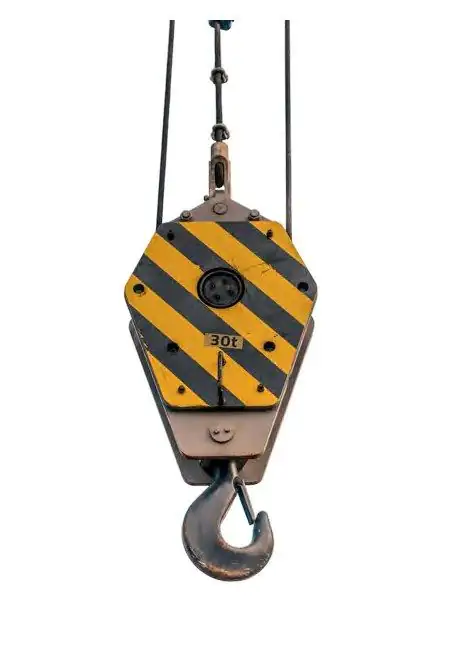
In short: the hook is the one part of a crane that touches every load, and a hook failure drops the load. ASME B30.10 sets the removal criteria most inspection programmes in the Kingdom follow: a throat opening increase of more than 5 per cent (not exceeding 1/4 in, about 6 mm), any visibly apparent bend or twist, wear of more than 10 per cent of the original section, and any crack. Regular inspection against a recorded baseline, with periodic NDT, catches problems early. BTGC supplies Gosan forged and laminated hooks and complete hook blocks.
Hooks are forged to be ductile: when overloaded they stretch and open before they break. That is a safety feature only if someone notices the stretch. Inspection programmes therefore measure the hook against its original dimensions and look for the signs of overload, wear and fatigue before they become dangerous.
Removal criteria in ASME B30.10
| Condition | Remove from service when |
|---|---|
| Throat opening | Increased by more than 5 per cent of the original dimension, not exceeding 1/4 in (about 6 mm), unless the manufacturer specifies otherwise |
| Bend or twist | Any visibly apparent bend or twist from the plane of the unbent hook |
| Wear | More than 10 per cent of the original sectional dimension, unless the manufacturer specifies otherwise |
| Cracks, nicks and gouges | Any crack; nicks and gouges unless removed by grinding as the manufacturer allows |
| Latch | Inoperative or missing where a latch is required |
| Heat damage or unauthorised repair | Any sign of welding, heating or repair not approved by the manufacturer |
OSHA 1910.179 uses looser limits of 15 per cent throat opening and 10 degrees of twist, but the stricter ASME criteria, together with the hook maker's own limits, are the safer basis for a lifting procedure.
Inspection frequency
Before use. A visual check by the operator for deformation, cracks, latch function and damage.
Frequent (monthly in normal service). A documented visual check of throat opening, twist and wear.
Periodic (typically yearly, more often in severe service). A thorough inspection with measurements against the baseline, and NDT where the procedure requires it or after an incident.
After any overload or shock load. Remove the hook from service and inspect it before reuse.
Measure from a baseline
Throat opening limits only work if the original dimension is known. Good practice is to record a measurement between two fixed gauge marks when the hook is new and keep it in the crane file; many forged hooks come with these marks from the maker. Without a baseline, inspectors can only compare with drawings and tolerances, which is far less sensitive.
Non-destructive testing
Magnetic particle inspection of the bowl, shank and thread region finds surface fatigue cracks long before they are visible. The shank thread and nut on a hook block are hidden fatigue points and should be examined whenever the block is dismantled. Laminated ladle hooks used in melt shops have their own inspection points on the plates and pins, described in laminated ladle hooks.
The rest of the hook block
Thrust bearing and swivel: free rotation without roughness or play.
Sheaves: groove wear and bearing condition, as covered in crane sheaves and wire rope life.
Side plates, pins and fasteners: deformation, wear and secure locking.
Gosan from BTGC
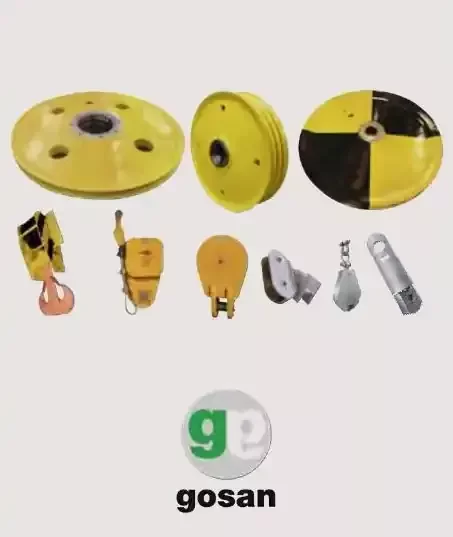
Gosan manufactures forged and laminated hooks, hook blocks, sheaves and crane wheels for crane makers, steel plants and ports. BTGC is the Gosan partner in Saudi Arabia. See also crane wheel wear and the mining and material handling page.
Questions buyers ask
Can a hook with an opened throat be bent back? No. Heating or bending a hook to restore its shape is not allowed unless the manufacturer approves it; the hook must be replaced.
Can Gosan supply a hook to match our existing block? Yes. Send the hook block drawing, or the hook number, capacity and shank dimensions.
What documents should a new hook come with? Proof load test and material certificates, and the hook should be marked with the maker's identification and rated load.
Contact BTGC
Email info@btc-ksa.com or call +966 13 856 0528. Branches: Dammam, Jubail and Yanbu. Request a quote.