In short: every metre drilled adds rock cuttings to the drilling fluid. If they are not removed, fine solids build up, mud weight and viscosity climb, penetration slows, and the rig spends more on dilution, chemicals and waste haulage. A solids control system removes solids in stages by size: shale shakers first, then hydrocyclones, then decanter centrifuges, with cuttings dryers recovering fluid from the discharge. BTGC supplies Elgin Separation Solutions solids control equipment and parts for rigs in the Kingdom.

Saudi land rigs drill long sections with water-based and oil-based muds. Drilled solids that stay in the mud are ground finer every time they pass through the pumps and the bit, until they are too small for any equipment to remove. The cheapest solid to remove is the one taken out on the first pass, while it is still large.
Each stage removes a size range
| Equipment | Typical cut point | Role |
|---|---|---|
| Scalping shaker or gumbo removal | Large cuttings and clay balls | Protects the main shakers in fast, sticky intervals |
| Shale shakers | About 75 to 150 microns, set by the screen | Primary removal and the most important stage |
| Desander (10 to 12 in cones) | About 45 to 75 microns | Removes sand-size solids from unweighted mud |
| Desilter (4 to 5 in cones) | About 15 to 35 microns | Removes silt from unweighted mud |
| Mud cleaner | Hydrocyclones over a fine screen | Lets weighted muds keep barite while removing drilled solids |
| Decanter centrifuge | About 2 to 10 microns | Removes fine low-gravity solids or recovers barite |
Cut points vary with mud properties, feed rate and equipment condition; the figures above are typical ranges, not guarantees.
Shakers do most of the work
If shakers run with torn screens, flooded decks or screens coarser than the hole allows, everything downstream is overloaded. API RP 13C gives a standard designation for screens based on the particle size they separate, so screens from different makers can be compared. The goal is the finest screen that handles the full flow without losing mud over the end of the deck.
Weighted muds and barite
Hydrocyclones discard barite along with drilled solids, so on weighted muds they are used only as a mud cleaner, with a fine screen under the cones returning barite to the system. A centrifuge can be set to strip low-gravity solids and return barite, and a second machine can clean the liquid further. Keeping low-gravity solids low is one of the main ways to control mud weight and rheology.
Fluid recovery and waste
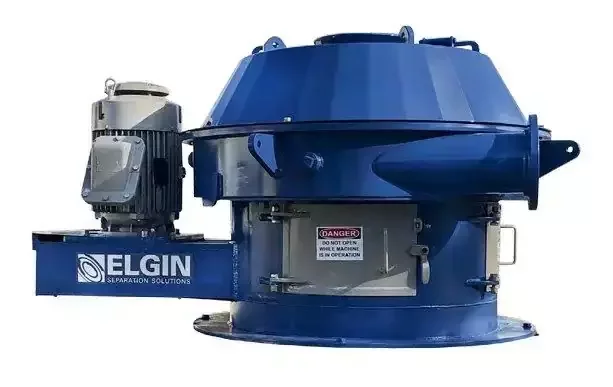
Cuttings leaving the shakers carry a lot of mud, especially oil-based mud. Vertical cuttings dryers and high-speed centrifuges recover much of that fluid and reduce the waste volume that must be hauled and treated, as covered in cuttings dryers and drilling fluid recovery. The recovered fluid returns to the active system after centrifuging.
Keeping the system effective
Check screens at every connection and replace torn panels at once.
Keep hydrocyclone feed pressure at the maker's value; a roping or spraying underflow shows the cone is overloaded or worn.
Measure solids content and mud weight in and out of each unit to judge efficiency, not just running hours.
Plan centrifuge overhauls (scroll wear, bearings, balancing) between wells to avoid failures while drilling.
Elgin from BTGC
Elgin Separation Solutions builds shale shakers, hydrocyclone units, mud cleaners, decanter centrifuges, cuttings dryers and screens for drilling and industrial separation. BTGC is the Elgin partner in Saudi Arabia, with centrifuge overhaul support at the BTGC service center in Jubail. See also decanter centrifuges for oily sludge and the drilling solutions page.
Questions buyers ask
Can Elgin screens fit other makers' shakers? Replacement screens are made for many common shaker models; BTGC confirms the fit from the shaker model and screen type.
How do we know the solids control system is working? Compare low-gravity solids, mud weight and dilution volume against targets; rising dilution is often the first sign the system is falling behind.
Do you service centrifuges between wells? Yes. BTGC supports scroll and bearing repair, balancing and parts supply for decanter centrifuges.
Contact BTGC
Email info@btc-ksa.com or call +966 13 856 0528. Branches: Dammam, Jubail and Yanbu. Request a quote.