In short: large slow-speed reciprocating compressors in refineries, gas plants and hydrogen units are often driven by synchronous motors. They run at exact speed, can improve plant power factor, and in low-speed, high-power duties they are more efficient than induction motors. The compressor's torque pulses every revolution, so the motor, coupling and shaft must be designed together to limit current pulsation and avoid torsional resonance. API 546 covers brushless synchronous machines above 500 kVA. BTGC supplies Electric Machinery synchronous motors.
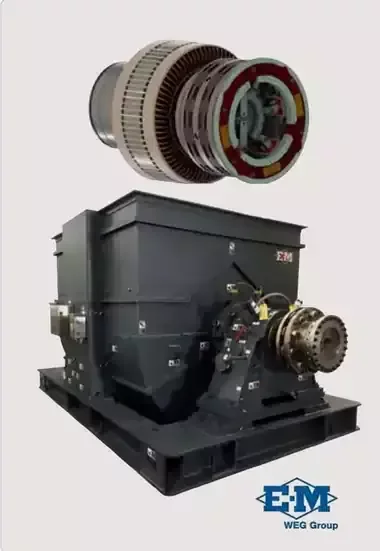
A reciprocating compressor running at a few hundred rpm and several megawatts is a demanding load. Direct-coupled synchronous motors avoid gearboxes, deliver high efficiency and allow leading power factor operation, which can offset reactive power drawn by the many induction motors in the same plant.
Why synchronous motors suit these duties
Constant speed set by supply frequency and number of poles, with no slip.
Adjustable excitation lets the motor run at unity or leading power factor.
High efficiency in low-speed, high-power ratings, where induction motors have low power factor and efficiency.
Large air gaps and robust rotor construction suit heavy pulsating loads.
Pulsating torque and current pulsation
| Issue | What is done about it |
|---|---|
| Torque varies through each revolution | Flywheel effect (rotor inertia) is chosen so speed variation stays small |
| Stator current pulsates with the torque | Inertia and compressor crank arrangement are set to keep current pulsation within limits, commonly 40 to 66 percent depending on the purchaser and API 618 practice |
| Torsional resonance | A torsional analysis of motor, coupling and compressor checks natural frequencies against excitation frequencies |
| Starting | Starting method (across-the-line, reduced voltage or VFD) and the amortisseur winding are designed for the compressor's unloaded starting torque |
What API 546 covers
Brushless synchronous machines of 500 kVA and above for petroleum, chemical and other industrial services.
Design requirements for stator, rotor, amortisseur winding and brushless exciter.
Bearings, lubrication, vibration limits and balance.
Testing, including routine tests and optional complete tests, with documentation requirements.
Maintenance and service
Monitor stator winding temperature, bearing temperature and vibration; see motor vibration analysis.
Check exciter diodes, fuses and field current; a failed diode reduces excitation and can cause pull-out.
Inspect the amortisseur bars and end rings for cracking after frequent starts.
Carry out insulation resistance, polarisation index and partial discharge tests at overhauls.
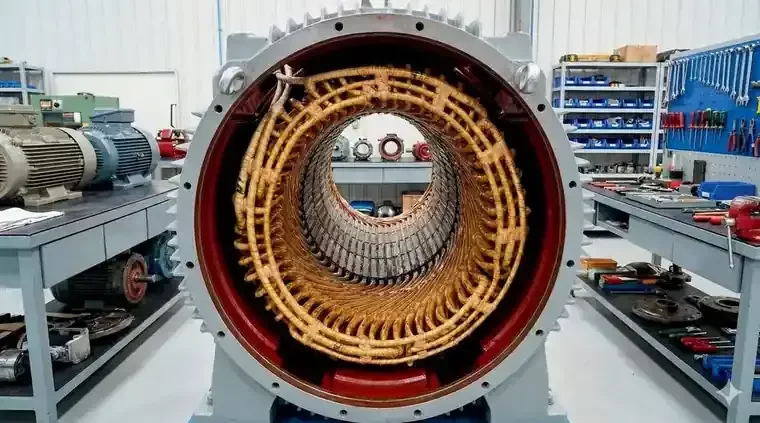
Plan rewinds and rotor repairs at a qualified workshop; BTGC's Jubail service center provides full electric motor services.
Electric Machinery from BTGC
Electric Machinery (WEG group) builds synchronous motors and generators, including slow-speed machines for reciprocating compressors and high-speed machines for turbo drives. BTGC is the Electric Machinery partner in Saudi Arabia. See also HV motor rewind or replace, rotating equipment and the electrical power systems page.
Questions buyers ask
Can a synchronous motor correct plant power factor? Yes. Running with extra field current makes it supply reactive power, improving the plant power factor.
Is a VFD needed? Not always. Many compressors start across-the-line or with reduced voltage; VFDs are used where capacity control or soft starting is needed.
Can BTGC repair synchronous motors? Yes, at the Jubail service center, with full electric motor services.
Contact the BTGC power division
Email power@btc-ksa.com or call +966 13 856 0528. Branches: Dammam, Jubail and Yanbu. Request a quote.