In short: trunnion-mounted ball valves are the standard isolation valve for oil and gas pipelines. The ball is held by trunnions, and spring-loaded seats press against it, which keeps operating torque low even in large sizes and high pressure classes. API 6D defines the seat functions buyers must specify: double block and bleed (DBB), and double isolation and bleed (DIB-1 and DIB-2). Getting these right decides how safely a section can be isolated for maintenance. BTGC supplies KPC trunnion ball valves up to 60 inch.
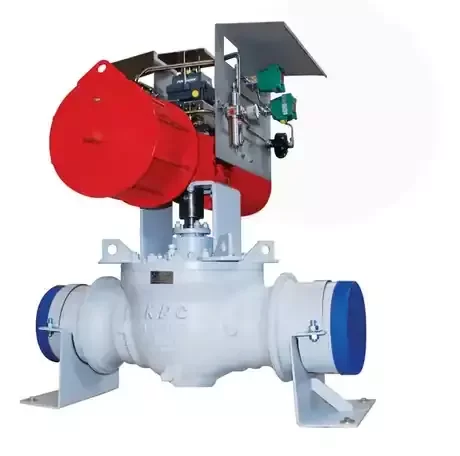
Cross-country crude, product and gas pipelines, gas plants and gathering systems in the Kingdom rely on large-bore ball valves for block valves, launcher and receiver isolation, and station isolation. Owners such as Saudi Aramco add their own specifications on top of API 6D for materials, testing and documentation.
Floating or trunnion-mounted?
In a floating ball valve the ball is pushed by line pressure onto the downstream seat; torque rises quickly with size and pressure.
In a trunnion-mounted valve the ball is fixed on its axis and the seats move; line pressure pushes the seats onto the ball, so torque stays manageable.
Trunnion designs are normal for larger sizes and higher pressure classes, and for valves that must be pigged (full bore).
Seat functions under API 6D
| Term | Meaning |
|---|---|
| Self-relieving seat (single piston effect) | Seals against upstream pressure; relieves body cavity overpressure into the line |
| Double piston effect seat | Seals against pressure from either side, including from the body cavity |
| DBB | Closed valve seals against pressure from both sides, with the body cavity bled |
| DIB-1 | Both seats seal in both directions |
| DIB-2 | One seat seals in both directions, the other in one direction only |
Double piston effect seats can trap pressure in the body cavity. As the valve warms in the sun, trapped liquid expands; a cavity relief valve or a self-relieving seat on one side is needed. This matters in Saudi summers, where buried and exposed pipelines see large temperature swings.

Other specification points
Side-entry or top-entry construction; fully welded bodies for buried service; extended stems and vent and drain lines.
Emergency sealant injection fittings on seats and stems.
Fire testing to API 6FA or API 607, and fugitive emission testing to ISO 15848-1; see fire-safe valves.
Sour service materials to NACE MR0175 / ISO 15156 where H2S is present.
Gearbox or actuator sized with margin for the breakaway torque after long periods closed.
Testing
Hydrostatic shell test and seat tests in both directions as API 6D requires.
Supplementary gas seat tests, cavity relief tests and DBB/DIB function tests as the purchaser specifies.
Material certificates and full traceability for pressure-containing parts.
KPC from BTGC
KPC Corporation of Korea supplies trunnion-mounted ball valves up to 60 inch, through-conduit slab and expanding gate valves and subsea valves for oil and gas transmission. BTGC is the KPC partner in Saudi Arabia. See also ITAG Saudi-made pipeline valves, actuator sizing and the oil and gas sector page.
Questions buyers ask
Is DBB the same as DIB? No. DBB seals against pressure from both sides with the cavity bled; DIB means each seat can isolate on its own, which gives higher integrity for maintenance isolation.
Do pipeline ball valves need a cavity relief? Valves with double piston effect seats usually do, to protect against thermal expansion of trapped fluid.
Can BTGC supply actuated valves? Yes, complete with gear operators or electric, pneumatic or gas-over-oil actuators.
Contact the BTGC valve team
Email valves@btc-ksa.com or call +966 13 856 0528. Branches: Dammam, Jubail and Yanbu. Request a quote.