In short: when the water is below the pump, at a seawater intake, a cooling water basin or a well, the usual answer is a vertical turbine pump: bowls and impellers submerged in the water, a line shaft up through the column, and the motor on top at dry level. Mixed flow and propeller versions move large flows at low head. Most problems come from the intake rather than the pump: vortices, poor submergence and sand. Materials for Gulf and Red Sea water, bearing lubrication and vibration control decide service life. BTGC supplies Pentair vertical turbine, mixed flow and propeller pumps.
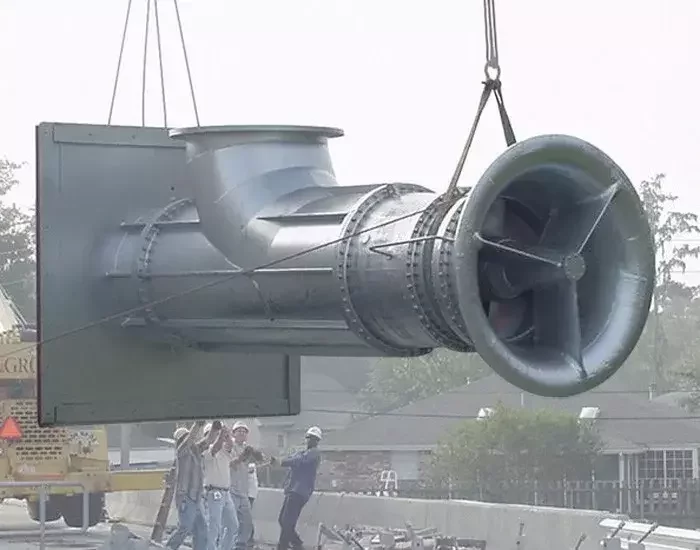
Coastal power stations, desalination plants, refineries and petrochemical complexes in Jubail, Ras Al Khair, Yanbu and Rabigh draw huge volumes of seawater for cooling and process. Inland, deep wells supply water to towns, farms and mines. Vertical turbine pumps serve all of these, from small well pumps to large intake pumps.
Main types
| Type | Flow and head | Typical duty |
|---|---|---|
| Vertical turbine (radial bowls) | Moderate flow, high head, often several stages | Wells, high-lift water supply, fire water |
| Mixed flow | High flow, medium head | Seawater intake, cooling water circulation |
| Propeller (axial flow) | Very high flow, low head | Large cooling water and drainage duties |
| Deep-set well pumps | Many stages, long columns | Groundwater supply |
The intake decides reliability
Design pump bays and sumps to ANSI/HI 9.8 (pump intake design): enough submergence, smooth approach flow, and correct clearances to floor and walls.
Free-surface and submerged vortices cause vibration, noise, cavitation and loss of flow; large intakes are often checked with a physical or CFD model.
Keep intake screens clean; blocked screens lower the water level in the bay and starve the pumps.
Sand and silt wear bowls, wear rings and bearings; locate suctions away from the sea bed where possible.
Materials for seawater
Duplex and super duplex stainless steels for bowls, impellers, shafts and column parts are common for long life in warm, saline water.
Nickel aluminium bronze is used for bowls and impellers in some designs.
Avoid mixing materials that create galvanic corrosion, and consider cathodic protection for large pumps.
Chlorination for marine growth control affects material choice; tell the supplier the dosing regime.
Bearings, shafts and vibration
Line shaft bearings are usually lubricated by the pumped water; in sandy water, clean flushing water extends bearing life.
Thrust from the impellers is carried by the motor thrust bearing in a vertical hollow-shaft or solid-shaft motor; size the motor for the full axial load.
Check the reed (structural) natural frequency of the motor and discharge head against running speed, especially with variable speed drives.
Monitor vibration at the motor top and the discharge head; rising levels often mean bearing wear or intake problems. See vibration analysis for large motors.
Pentair pumps from BTGC
BTGC is the Pentair partner in Saudi Arabia for vertical turbine, mixed flow and propeller pumps, with motors from WEG and intake screens from Elgin. See also cooling tower water and the power and utilities sector page.
Questions buyers ask
What data does BTGC need for a vertical pump enquiry? Flow, head, water levels (minimum and maximum), sump or well dimensions, water analysis and temperature, and the power supply.
Can an old intake pump be upgraded rather than replaced? Often yes: new bowls and impellers in better materials, or a re-rate to new flow conditions, can reuse the column and discharge head.
Why does a pump vibrate only at low water level? Low submergence lets vortices form and draw air; check the levels and the intake design.
Contact BTGC
Email info@btc-ksa.com or call +966 13 856 0528. Branches: Dammam, Jubail and Yanbu. Request a quote.