In short: when a control valve takes a large pressure drop, the liquid can briefly fall below its vapour pressure inside the trim. The vapour bubbles then collapse downstream, eating away plugs, seats and bodies; this is cavitation. If the outlet pressure stays below vapour pressure the fluid flashes instead. In gas service, high pressure drop makes noise and vibration. Standard single-stage trims cannot cope, but multi-stage, velocity-controlled trims split the drop into steps and keep velocities low. BTGC supplies KOSO severe service control valves.
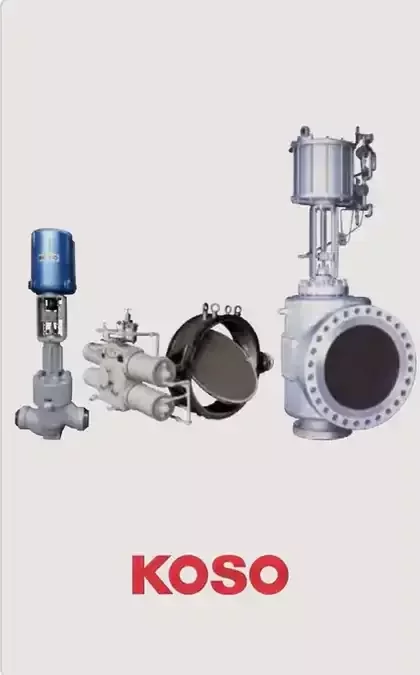
Boiler feedwater recirculation, spray water, pump minimum flow, separator level control, high pressure letdown and compressor anti-surge valves are all classic severe service duties in Saudi refineries, gas plants and power stations. These valves often fail in months rather than years if the trim is not designed for the pressure drop.
What happens inside the valve
Flow accelerates through the narrowest point of the trim, the vena contracta, and pressure falls there before partly recovering downstream.
If the pressure at the vena contracta drops below the liquid vapour pressure, vapour bubbles form; when pressure recovers they implode against metal surfaces. This is cavitation.
If the downstream pressure itself is below vapour pressure, the liquid flashes to vapour and leaves as a high-velocity two-phase flow that erodes the body and piping.
At a certain pressure drop the flow chokes: increasing the drop no longer increases flow. IEC 60534-2-1 uses the liquid pressure recovery factor FL to predict this.
In gas and steam service, a high pressure ratio creates aerodynamic noise and pipe vibration. Many plants limit noise to about 85 dBA at 1 m, predicted with IEC 60534-8-3.
How severe service trims solve it
| Approach | How it helps |
|---|---|
| Multi-stage pressure reduction | Takes the total drop in several smaller steps, so the pressure never falls below vapour pressure at any stage |
| Velocity control | Limits trim outlet velocity and kinetic energy; KOSO uses multi-stage Vector Velocity Control (VVC) trims for this |
| Hardened materials | Stellite, hardened stainless or other hard-faced trims resist the damage that remains |
| Angle bodies and outlet design | Direct flashing flow away from the body walls into a larger outlet |
| Low-noise trims and diffusers | Split gas flow into many small jets to shift noise to frequencies the pipe radiates less |
Many severe service specifications limit trim exit kinetic energy, often to around 480 kPa (70 psi) for continuous duty, and use cavitation indexes to decide when an anti-cavitation trim is needed. The valve maker should check every operating case, not only the design point: start-up and low-load conditions are often the worst.

Signs of trouble in service
A gravel-like noise in liquid service or a loud whistle or roar in gas service.
Vibration of the actuator, positioner and nearby piping; loose fittings and tubing failures.
Rising seat leakage and loss of control at low openings.
Pitting or wire-drawing on plugs and seats at overhaul; erosion of the body downstream of the seat.
Positioner diagnostics that show increasing friction or travel deviation, as described in control valve positioner diagnostics.
What to send for a severe service selection
All operating cases: minimum, normal and maximum flow with inlet and outlet pressures and temperatures.
Fluid properties, including vapour pressure and critical pressure for liquids.
Line size and schedule, allowable noise and required shutoff class.
Existing valve data and failure history if it is a replacement.
KOSO from BTGC
Nihon KOSO supplies severe service control valves, high-performance butterfly valves, actuators, positioners and choke valves. BTGC is the KOSO partner in Saudi Arabia, with valve testing and repair at the BTGC service center in Jubail. See also control valve sizing, control valve overhaul and the flow control and valves page.
Questions buyers ask
Can a standard globe valve be upgraded with an anti-cavitation trim? Sometimes, if the body can accept a multi-stage trim with enough capacity; otherwise a new valve is needed. BTGC can check the existing valve data.
Why does damage appear downstream of the valve? Bubbles collapse where pressure recovers, which can be in the outlet or the pipe just after the valve.
Does a larger valve reduce cavitation? No. Cavitation depends on the pressure drop and trim design, not the body size.
Contact the BTGC valve team
Email valves@btc-ksa.com or call +966 13 856 0528. Branches: Dammam, Jubail and Yanbu. Request a quote.