In short: pressure vessels and heat exchanger shells in refineries and petrochemical plants are inspected throughout their lives under API 510. The code sets external and internal inspection intervals, ties them to corrosion rate and remaining life, and controls repairs, alterations and rerating. Risk-based inspection to API 580 and 581 can adjust intervals where justified. Good inspection data also tells owners when a vessel or bundle should be replaced rather than repaired. BTGC supplies Hemaco pressure vessels, heat exchangers and replacement components.
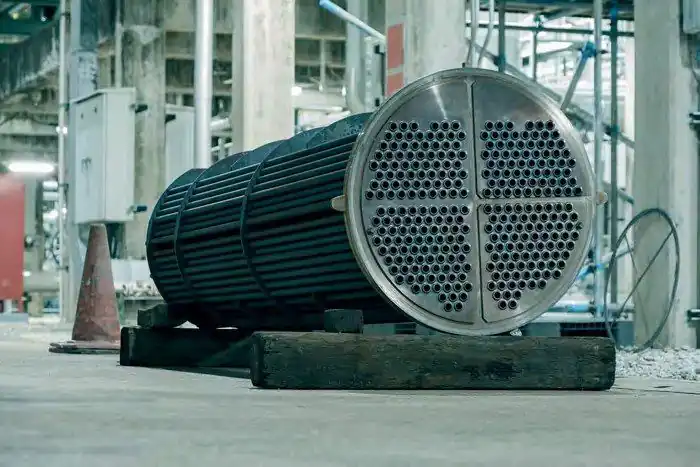
API 510 applies to pressure vessels in petroleum refining and chemical process service once they are in service. Saudi operators apply it together with their own engineering standards. For owners, the code answers three questions: how often to inspect, how to decide whether a vessel is still fit to run, and how repairs must be done.
Inspection intervals in API 510
| Inspection | Interval basis |
|---|---|
| External visual | At least every 5 years, or at the internal or on-stream interval if that is shorter |
| Internal or on-stream | Not more than half the remaining corrosion life or 10 years, whichever is less, unless a risk-based inspection assessment supports another interval |
| Pressure relief devices | Under the plant's relief device programme, as covered in safety relief valve testing |
Remaining life comes from measured thickness, the required minimum thickness and the corrosion rate calculated from successive measurements. Where remaining life is short, intervals shorten automatically.
Risk-based inspection
API 580 and API 581 describe risk-based inspection (RBI), which ranks equipment by probability and consequence of failure and sets inspection scope and timing accordingly. RBI can extend intervals for low-risk vessels and focus effort on high-risk ones, but it must be documented, reviewed and updated when conditions change.
What inspectors look for
General and localised corrosion, measured by ultrasonic thickness readings at fixed locations.
Cracking at welds and nozzles, especially in services prone to stress corrosion cracking such as caustic, amine and wet H2S.
Corrosion under insulation on vessels operating in the temperature range where it is most active.
The damage mechanisms listed in API 571 for the specific service.
For exchangers, shell and channel corrosion as well as tube bundle condition, described in retubing or replacing an exchanger.
Repairs, alterations and rerating
Repairs and alterations must be authorised by the inspector and engineer, use qualified welding procedures, and meet the original construction code or an accepted alternative.
A fitness-for-service assessment to API 579-1/ASME FFS-1 can justify continued operation with defects within calculated limits.
Rerating a vessel to a new pressure or temperature requires calculations, possibly a pressure test, and an updated nameplate.
When repairs become frequent or extensive, replacing the vessel or bundle with a design better suited to the service is often cheaper over its life.
Hemaco from BTGC
Hemaco designs and fabricates pressure vessels, shell and tube heat exchangers and air coolers to ASME and TEMA, including replacements built to the original dimensions with upgraded materials where corrosion has been a problem. BTGC is the Hemaco partner in Saudi Arabia. See also exchangers in special alloys, tube-to-tubesheet joints and the petrochemicals sector page.
Questions buyers ask
Does API 510 apply to heat exchanger shells? Yes. Exchanger shells and channels are pressure vessels and are inspected under API 510 and the owner's programme.
Can a corroded vessel keep running? Possibly, if a fitness-for-service assessment shows it is safe for the planned period with monitoring; otherwise it must be repaired or replaced.
What does Hemaco need to build a replacement? The original data sheet and drawings, nameplate details, inspection findings and any process changes since the vessel was built.
Contact BTGC
Email info@btc-ksa.com or call +966 13 856 0528. Branches: Dammam, Jubail and Yanbu. Request a quote.